When designing the best composite bike wheel, reduced weight is only one part
Carbon fibre-reinforced polymers are used for many reasons. A well-known one is to lightweight something. Jon Partington from Partington CC explains that a holistic approach to materials and overall performance is what's needed to build the best bicycle wheels, and shares some of the Geelong company's plan to scale up at its new factory.
Lightweight inspired Jon Partington’s work on composite-based bike wheels, specifically the German company named Lightweight, which is credited with producing the first all-carbon fibre bike wheel in 1994.
After beginning his career in high-performance automotive in England, he moved to Australia in 2010, “off the back of the GFC.”
A stint at Ford Australia was followed by finishing an engineering degree and then commencing a PhD at Deakin University. His thesis work? Novel design and manufacturing processes for complex composite parts.
Partington began making his German-inspired bike wheels in a garage at Torquay.
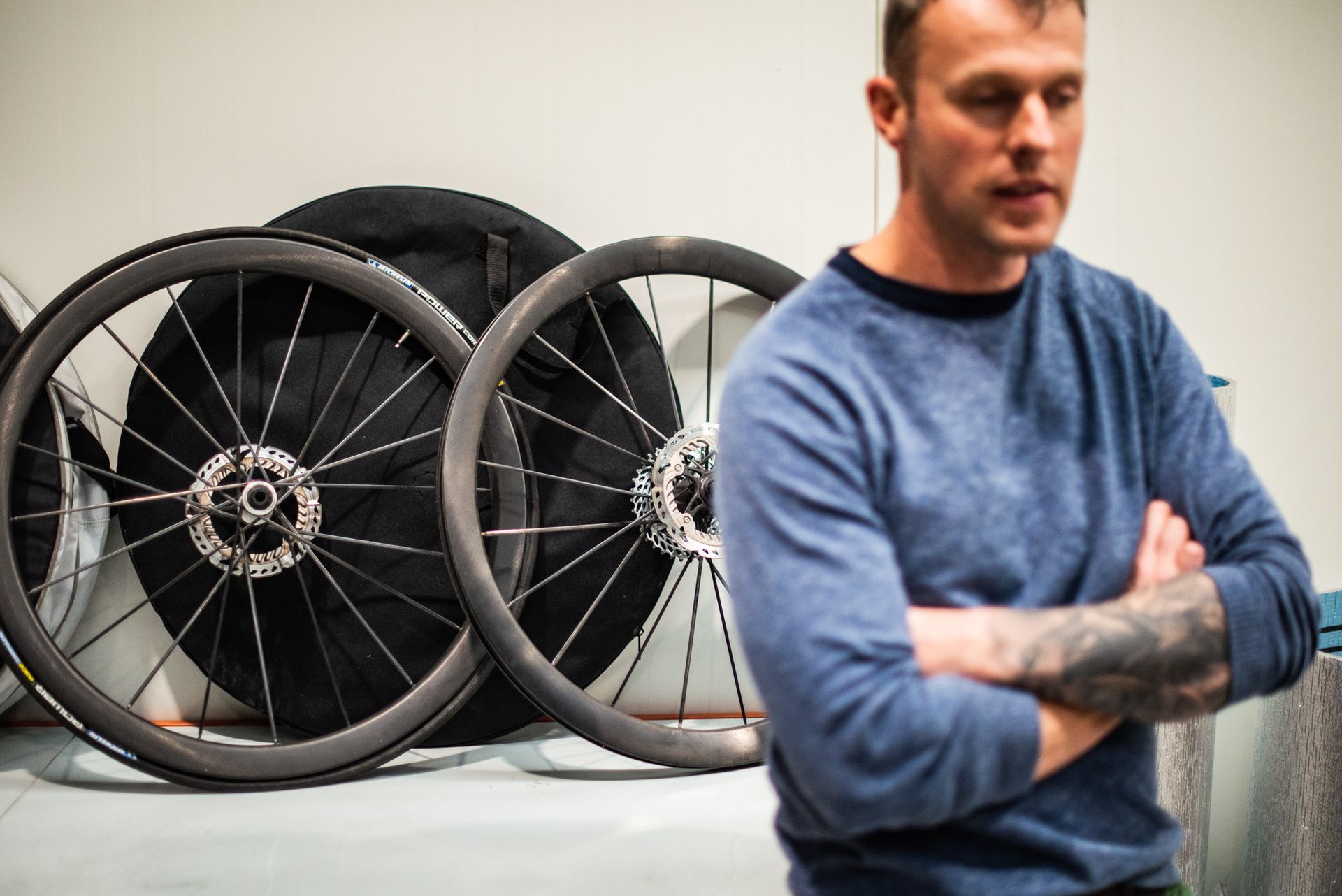
“That was just primarily to give me a bit more practised experience with the materials that I was doing the theoretical work on,” he explained.
These experiments at the frontier of bicycle wheels became a business – now known as Partington CC – in 2014, and the PhD was put on hold and then abandoned.
"Creating a business was too good an opportunity to pass up," he explained
The company set up alongside eight others in Deakin’s ManuFutures incubator (which officially opened in 2018) at Waurn Ponds.
Since 2025, home has been the new Wilmac Corio precinct in Geelong’s north.
Engineering tradeoffs
Far from being “all-carbon”, like Partington’s original inspiration, the bike wheels are complex in their make-up. The objective, though, is simple.
“To produce the highest performing bicycle wheels in the world. That's not the lightest or the stiffest or the most aero,” said Partington.
“It's this sort of considered blend of all those attributes because they're typically in competition with one another.”
Lightest, strongest, stiffest and most durable are parameters that work against each other, and optimisation for overall performance is complicated. Accordingly, so is the design of the wheels and the blend of inputs.
Cores are made of PMI foam, with metallic inserts also contributing to the structure. On the composites side, they exclusively use pre-preg materials in a variety of formats.
“So we have slit tapes, we've got unidirectional fabrics and we have woven fabrics. We use a mix of standard modulus, intermediate modulus and aramid fibres,” Partington added.
“We also use metallic inserts to make up the structure. It's a multi-materials design philosophy. We aim to be considerate of which materials we use, to capitalise on each’s useful attributes to achieve the best performance.
Industrialisation phase
When we spoke to the founder, the factory had “just gone live” with production, with an initial target rate of 10 pairs a day of wheels.
Output is entirely for export markets, with wheels – currently available in 18 SKUs – reaching riders via distributors, retailers and event managers catering to those “with significant means.”
Performance does not come cheap, with
Partington.cc’s website listing $12,450 as the RRP for a wheelset.
As the company looks to grow volumes, potential diversification avenues include time trial, gravel and perhaps mountain bikes. There are no plans to move outside of high-performance bikes.
Partington said that artificial intelligence is of interest as output increases for what is currently a boutique product. He cites identifying production bottlenecks from the data lake as one potential AI application.
Innovation and automation will continue to take labour out of and increase the quality of products. Labour in Australia is expensive, said the founder, and – as with companies wanting the most advanced semiconductors – those wanting the best bike wheels tend to use Taiwanese factories.
Another current challenge being addressed is a limited pool of skills available to Australian composite manufacturers. There is excellent research being done, but if you want skilled operators, you have to train them yourself, said Partington.
“We want to remove some of the more mundane processes from humans and use simple automation for that, as well as some more product-specific automated processes that we want to develop,” he added.
“Composites require quite a high degree of skill to get repeatable outcomes. And at the same time, we want to be producing tens of units a day, which is quite repetitive.
“To develop a process and/or find the right people that have the rigour and diligence required to get a good outcome, but are content with doing repetitive work, is actually quite challenging to do.”
Pictures: supplied
ACM CRC welcomes engagement from industry and research partners interested in collaborating on advanced composites manufacturing initiatives. Contact us
here.