Helping manufacturers “converse with their factory” using new AI tools
Associate Professor Scott Barnett is Deputy Head, Translational Research and Commercialisation at Deakin University’s Applied AI Institute (A2I2.) He’s also the lead on the ForgeX.ai factory management project, supported by the Australian Composites Manufacturing CRC (ACM CRC.) In this interview, Barnett shares some insights about his work ahead of his appearance at ACM CRC’s annual partner meeting, to be held on August 19–20.
ACM CRC: What does your career path look like?
SB: I did my undergrad and then I did a PhD in software engineering and robotics. I joined Deakin’s AI initiative, A2I2, to help companies use AI on contract research and development projects for the last nine years.
And over the last couple of years I've shifted to helping manufacturing companies quite a bit. And that's how I got involved with the ACM CRC.
ACM CRC: Why is applied research something that you apparently like doing?
SB: I think it's because it helps companies adapt and solve their problems with new technology. So you're constantly helping someone and have different problems each day.
I've done projects across telecommunications, finance, education, and manufacturing. A wide spectrum and range. It keeps things interesting.
ACM CRC: Part of your recent manufacturing work includes on alloys, but you're doing lots of other work as well. What are some R&D efforts within manufacturing?
SB: I'm part of the circAlloy Training Centre, which is more on the research side and is looking at how to recycle alloy materials. There I'm playing a role where I'm using AI and software to help augment researchers to make them more productive and more effective, helping push the circular economy forward.
I do stuff with generative AI, with quite a lot for a small startup at the moment, Red Velvet AI. That's building new technology for reviewing applications with a human in the loop. And then there's the work with the Overseer platform, which was supported by an Australia's Economic Accelerator (AEA) Ignite grant. That was with Carbon Revolution, as well as starting to look at ways in which we could help make software more affordable and more effective for SMEs.
ACM CRC: How did the ForgeX.ai - AI factory management project with us come about, and what does it aim to achieve?
SB: As I mentioned, we started with an AEA grant from the Australian Government to build a platform and to help do defect detection. That grant scheme was shut down recently, but we saw value in continuing that type of work for manufacturers. So we linked up with the ACM CRC and another partner to build a small project to help run and track experiments. It’s basically designed for micro-sized manufacturers.
It can help companies optimise what they do. We have been testing it at an artificial leather company. And then from that project we looked at a couple of other use cases, such as searching for and retrieving information using AI, basically helping manufacturers converse with their factory in natural language. From that, we realised that there are many other use cases where AI could come in. For example, manufacturers generally don't have in-house software engineering capabilities, yet they all rely on software. So we're looking at ways to build tools that can empower people who are not qualified software engineers, using AI to bridge the gap as far as we can.
ACM CRC: Tell us about the different components to ForgeX.ai
SB: There's a couple of parts. There's an underlying platform that can be hosted completely on-premise or in the cloud, depending on what the providers need. It's then got a set of apps that are available for people to use.
Currently the key apps that we have are the experiment platform that I was talking about where you can track those, Optilab, find related experiments and basically help optimise and find the best possible process. The other app is about searching and analysing the data that you've got. So it’s an agent that does basic data science, handles your queries, does analysis for you, and creates a report from natural language. The third one is designed to help people migrate or integrate between ERP systems.
ACM CRC: What sort of efficiency improvements can be delivered through these AI-powered apps?
SB: Perhaps a 30 - 50 per cent efficiency gain if a company doesn’t have an existing data system currently in use. They help save on time and the need for software help outside of the organisation. A lot more can be done with your existing teams and people.
Using AI agents and new technology reduces the need for custom-built software. And an organisation can structure and better use the content that's available. So in the experimentation example, there's already an existing database in this company, but it's not readily structured and able to be interrogated. It might be in Excel spreadsheets, documents, images and is harder to maintain and support. We put something over the top of that to make it more reliable and robust, which cuts administration work, basically.
ACM CRC: What does the development timeline look like?
SB: ForgeX.ai’s future is dependent on partners. Our approach is to really work closely with the partner to make sure that what they need is done.
From a technology perspective, we've done some iterations with the client. They're working with it and we're just waiting for more feedback from them. Our centre has a collaborative-type nature where we work with partners and it's dependent on their timelines and their priorities as well.
ACM CRC: What would you say about developing quality assurance software for smaller-sized manufacturers and how you approach that?
SB: There's a lot of active solutions off the shelf that are available for defect prediction, especially vision-type solutions. Typically, they have a lot of vendor lock-in, where they want to provide the whole thing and they have different scale up operations, which may not be viable for micro or small companies.
What we're trying to do is look at a low-cost way to set something up quickly that does a good enough job. And then we're looking for integration with the other systems.
With the Overseer platform, it's worth saying that we're designing it to sit across existing platforms within a company. We're not trying to replicate everything that's out there, but to add an intelligence layer over the top of what a company already uses. Rather than just have a bunch of bespoke things that don't connect or don't integrate well.
ACM CRC: What’s your point of view on how generative AI and agentic AI could reshape manufacturing? Are there any trends we should watch?
SB: It can do a lot more than what people are thinking. There's a lot more reasoning, surfacing up data and automation that can be done. I think a lot of it's going to be in the mundane and places where people aren't necessarily looking to put AI. There’s a lot in the way of migration problems, backend or back of house workflows that AI can come in and sort out.
I think that once people have figured out how to glue things together and deal with interoperability and data, I think agents will be able to do a lot more on top and surface up a lot more insights.
They'll be able to monitor, and ultimately what our collaboration with ACM CRC would like to show is that it can optimise processes and better keep track of data that manufacturers are already creating.
A lot of software systems I've seen are kind of “push”. A company will set them up, configure them, and then the system does what they want. With the agentic AI, I think things will be more “pull”. The system will be able to recommend options based on knowledge pulled in from a manufacturer, helping the company predict scenarios and operate better.
ACM CRC: Is there anything else worth mentioning?
SB: A2I2 has a desire to work more closely with companies. We have plenty of capability, and would like to see more direction from companies.
What we’ve talked about above is available to all manufacturers. The ACM CRC funding comes with a requirement that the results of the project are open source, so everybody benefits from the advancements, not just the companies that are getting involved.
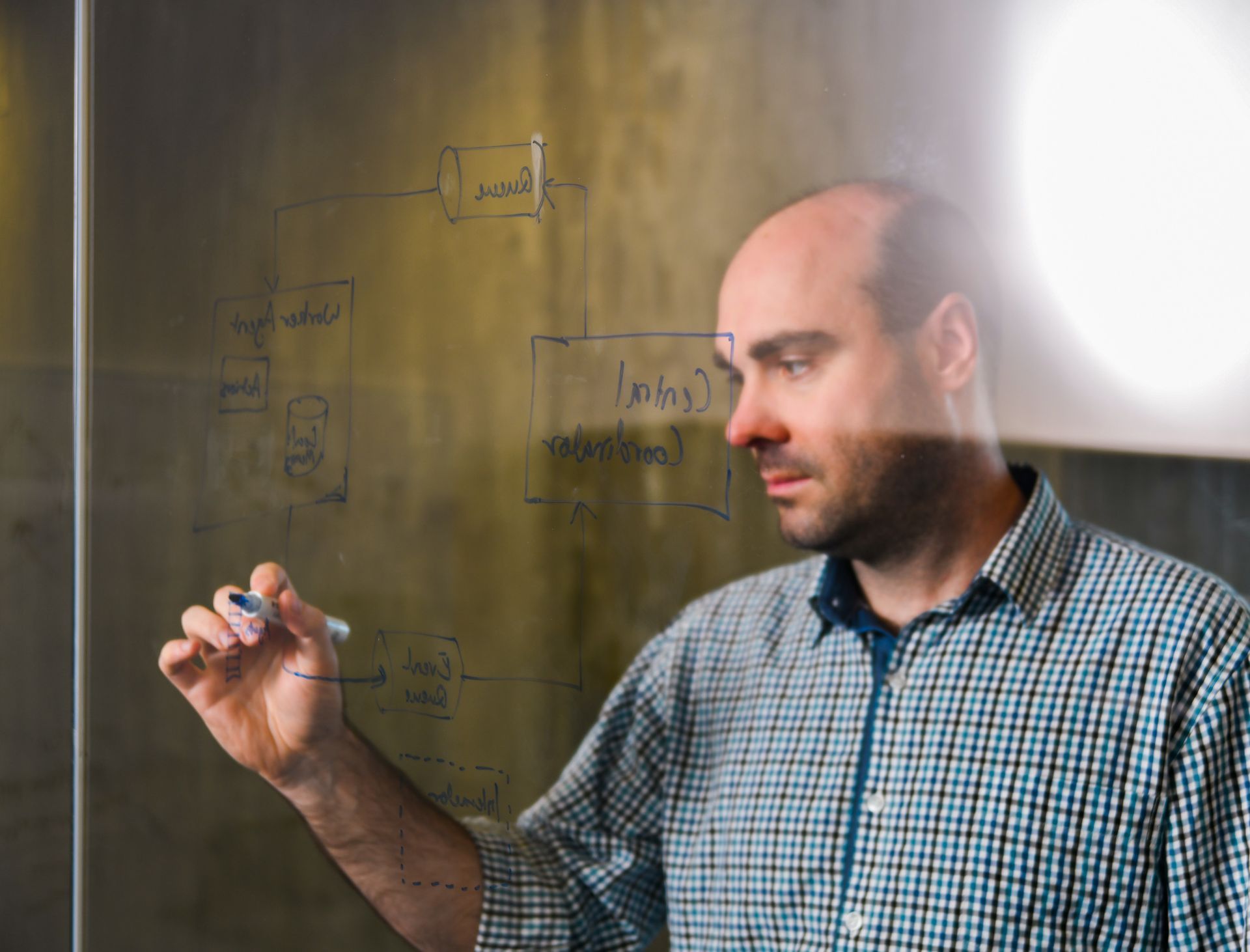
Picture: Scott Barnett (credit Deakin University)
ACM CRC’s annual Partner Meeting will be held on August 19 and 20 at Level 3, Salesforce Tower, Sydney. Barnett will present on an agentic AI solution for manufacturers, followed by a breakout session where partners can explore what it could mean for their organisation. More on A2I2 at this link, Barnett’s projects here, and the Partner Meeting here.