PhDs jump into the shark tank in Australian-first pitching competition
August 27 – Five doctoral students got a chance to rethink their research in commercial terms through a nation-first pitchfest at the Australian Composites Manufacturing Cooperative Research Centre (ACM CRC) annual Partner Meeting last week.
The quintet reframed their work to consider things like “TAM, SAM and SOM”, and how to turn their tech in materials and monitoring into business opportunities.
First place was taken out by Deakin University’s Sachini Dissanayake, pictured on the right above, alongside ACM CRC Chair Dr Abby Bloom.
Dissanayake shared how her research on chemical bonds might enable self-healing coatings for more resilient infrastructure. She told sharks that in Australia alone, capturing just a per cent of the $3.9 billion coatings market would mean $39 million in value.
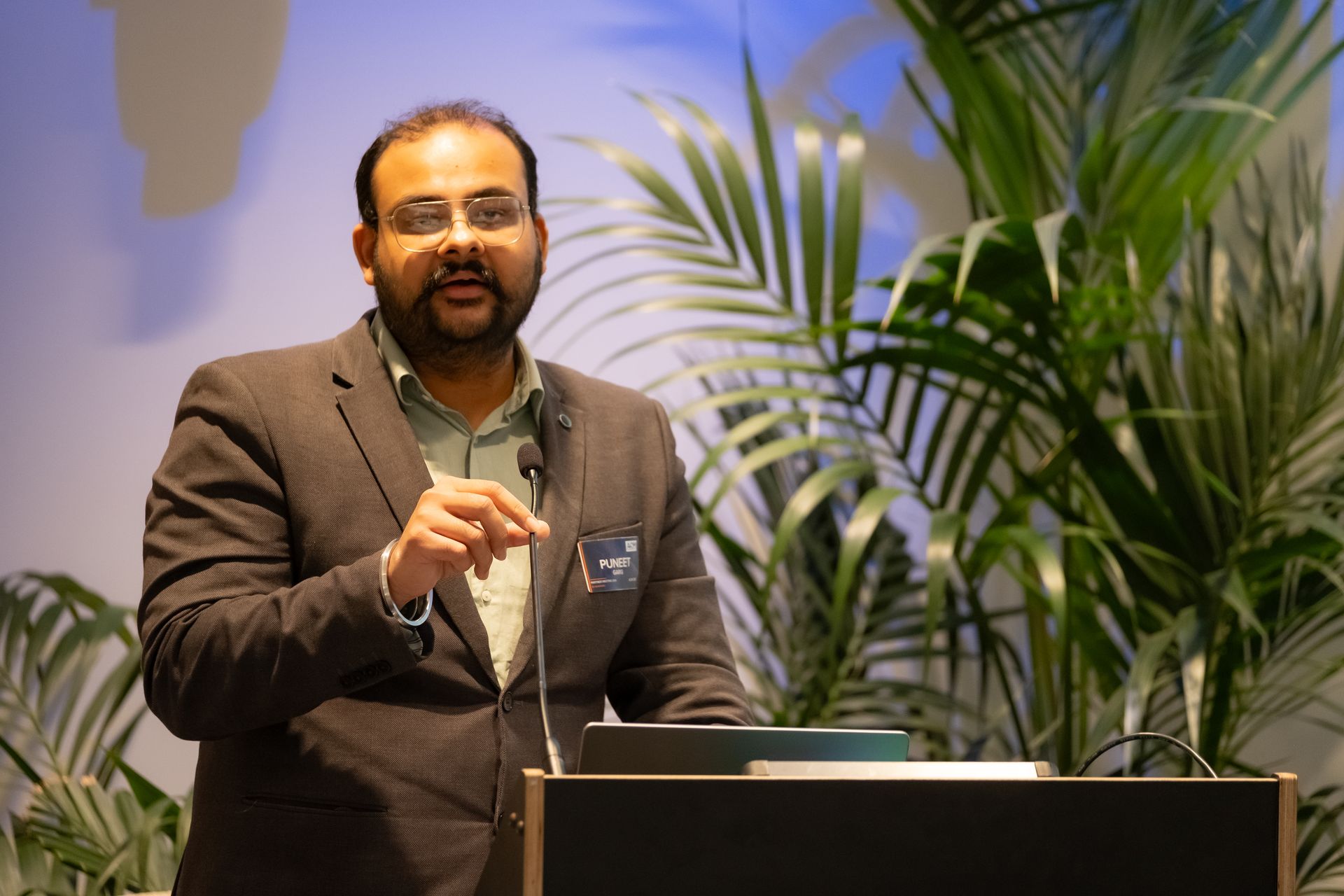
Opportunities for PhD candidates to present at conferences and events often tend to have a natural research-oriented inclination, explained ACM CRC Research Portfolio Manager Dr Puneet Garg (pictured above), who led the initiative.
“But when you're engaged in an R&D project funded by CRC – which promotes collaboration and helps solve industry problems through research – it becomes important to understand your PhD not just from a research point of view, but also from a commercial and economic impact point of view,” said Garg. “That was the premise behind what, to the best of our knowledge, is the first time such an effort has been coordinated through a CRC in the program’s 36-year history.”
Submissions were assessed against five criteria: innovation and technical credibility, commercial potential and market opportunity, alignment with national priorities, economic impact, and pitch delivery.
Finalists gave a Shark Tank-style pitch at the Partner Meeting, with audience members voting for their favourite with the idea that each vote represented $25,000 in investment.
Dissanayake’s PhD focus is a novel material, including various characterisations to evaluate its properties. She collected roughly $500,000 in backing.
Conducting a market analysis was something brand new, as was imagining a new business and product, named HEALCOAT.
“I saw the numbers and it actually motivated me more knowing, ‘Oh, this is a market that I can address too,’” she shared.
“I was so focused on developing the material and the scientific aspects and fine-tuning very small things, I lost track of the big picture. This helped me capture it again.”
Runner-up Sriram Ravishankar Padma recast his work – understanding resistance and strain contour correlation for structural health monitoring – as an enterprise named BONDSIGHT. Padma is a University of Western Australia student working with industry partner Fuze.
Market research on the TAM for composite repairs suggested a $US 22.8 billion global opportunity by 2031, and a local serviceable addressable market (SAM) of $216 million by 2030.
After deciding on a servitisation business model, sales of a certified technology (after further development) were tallied at $US 3 to $US 5 million a year.
“I’d like to emphasise that I am not selling the sensors here, but the commodity for sale is a qualified technology, which includes the procedure, the sensor layout, and the detection and prediction algorithm,” said Padma.
Third-placed Stephen Joseph from The University of Queensland presented his work on material systems and coatings for high temperature composites as an ingredient technology.
“Once you think about your markets and your customers, my technology isn't the product: my technology is an enabler to the product, which means that I might look at licencing as opposed to trying to create a product,” he shared after the event.
“I think that's where researchers – I wouldn't say go wrong – get very tunnel visioned on, ‘Hey, I've got this material, I can make the product.’”
University of Southern Queensland’s Neda Bozorgi said the exercise unearthed opportunities for her work on structural reinforcements based on bio-based glass fibre-reinforced polymers.
“When you are doing research, you only focus on different mechanical properties. Or you do calculations and you're just working with your results,” she offered.
“But you don't come out of your comfort zone and you don't think from a marketing view or about the financial impacts of your work.”UWA’s Jingjing Sun also targeted the need to get more value out of infrastructure by understanding its structural health, turning her thesis into a SaaS business enabling data-driven decisions.
“We already know from composite repair work for steel, that the problem is to have faster, more reliable repair decisions,” she told the audience.
“Our technology, Repairworks, is a digitalisation platform enabling faster, more reliable and scalable composite repair of ageing infrastructure.”
Garg said the inaugural run of the competition validated a broader belief: that a subset of PhDs already possesses a strong commercial mindset and business acumen, and simply need more opportunities to demonstrate these skills.
For others, competitions like this offer a structured pathway to build and sharpen their entrepreneurial skill. This dual purpose is what made the format a good fit, as it also strongly aligns with the CRC's Education & Training Program, which aims to upskill the next generation of the sector’s workforce.
He added that while not every study or research required a detailed plan on Serviceable Obtainable Market (SOM), understanding terms like Technology Readiness Level (TRL) and Commercial Readiness Level (CRL) had obvious benefits for PhDs.
“Once you finish your PhD, whether you go on to work in industry or academia, commercial know-how of the technologies being developed becomes really important,” said Garg.
“We also look forward to seeing new Australian companies emerge from PhD-discovered technology.”
Final results as voted by attendees at ACM CRC’s Partner Meeting 2026 are below.
Sachini Dissanayake, Deakin University
HEALCOAT
Self-Healing Coating (boronic ester dynamic bonds; damage-activated autonomous healing, no inspection needed)
Sriram Ravishankar Padma, University of Western Australia
BONDSIGHT
FRP-Steel Structures Health Monitoring
Stephen Joseph, University of Queensland
Siliconised Cf/C Composites
Hydrogen permeability barrier coating for regeneratively-cooled hypersonic propulsion
Neda Bozorgi, University of Southern Queensland
BIO-BASED EPOXY
GFRP composites, corrosion-resistant infrastructure resin
Jingjing Sun, University of Western Australia
REPAIRWORKS
Digital Repair Decision Platform (SaaS tool for fast/reliable composite repair assessment of ageing infrastructure)