Ocean plastic problem leads Perth founder to hyper-scale additive manufacturing
It was a holiday in Indonesia that led young engineer Joshua Wigley to do what he currently spends his days doing: building additive manufacturing (AM) machines that can make super-sized structures like boats, homes, and concrete formwork.
“I was in Bali at the time and there's a lot of plastic there piled up or in the rivers and the oceans, floating," the Hyperion Systems founder explained.
"And really the idea was 'what if we could combine all that plastic into something else that floats, like a boat?'”
“Myself and my co-founder were already in the 3D printing space and we thought, ‘okay, what if we just built a bigger version of a desktop printer and we just scale that up?’
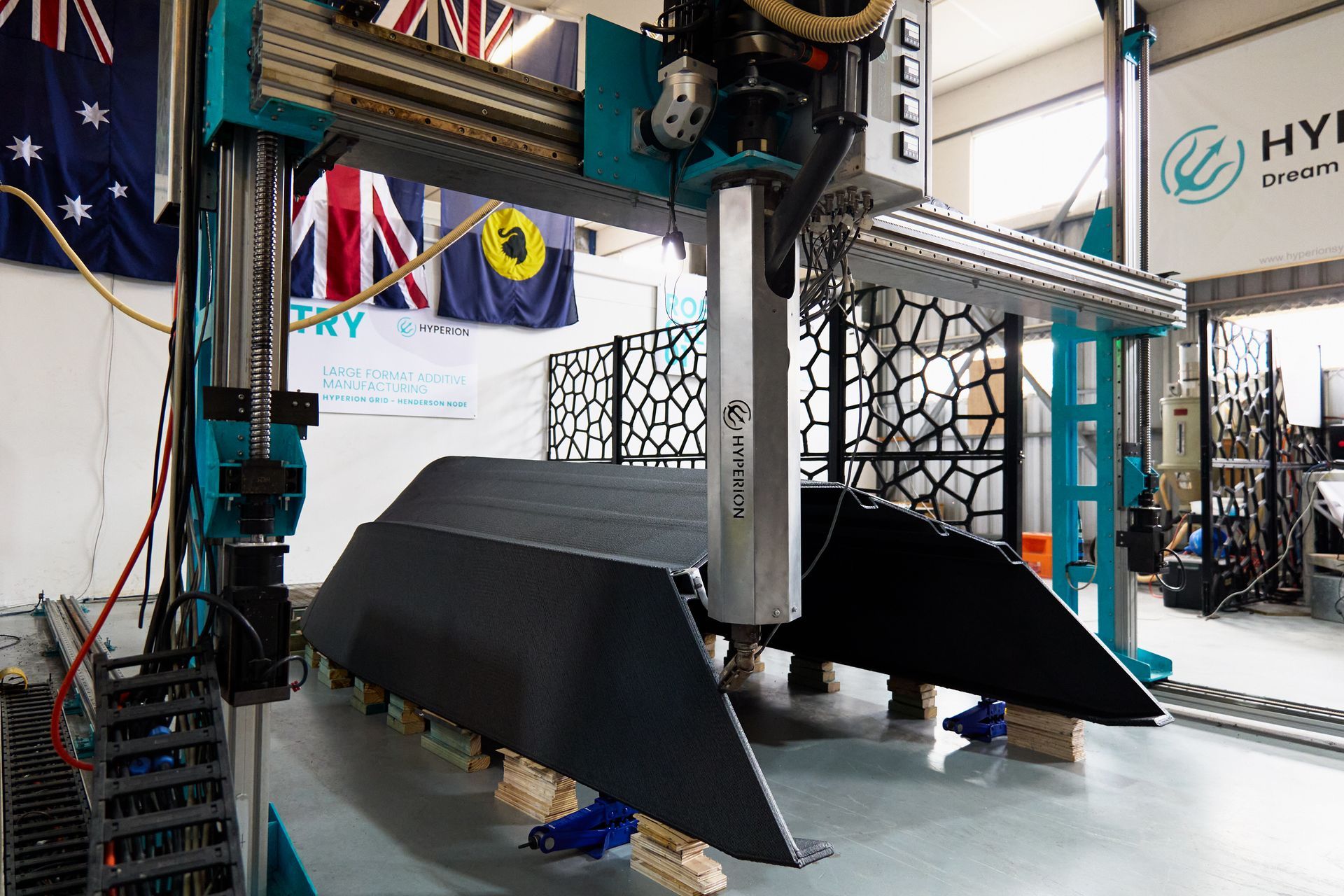
“So that's where we really started. We essentially built a machine that could print a boat. And then the business has turned into so much more than that.”
To add a tiny bit of symmetry to the story, Wigley said his company has just sold one of its machines to an unnamed Pacific island.
From establishment in 2022 to its current capital raise and imminent expansion, the company has pursued fused granulate fabrication (FGF) AM. This uses plastic pellets, melted and screw-driven out of a print-head, which is guided along by an industrial robot and software.
The technique is capable of much higher flow rates, material choices and build sizes than fused filament fabrication (FFF, one of the dominant types of printing.)
According to Hyperion, its TitanCell machines – available in 20-foot and 40-foot containerised versions – are able to lay down as much as 30 kilograms of plastic per hour.
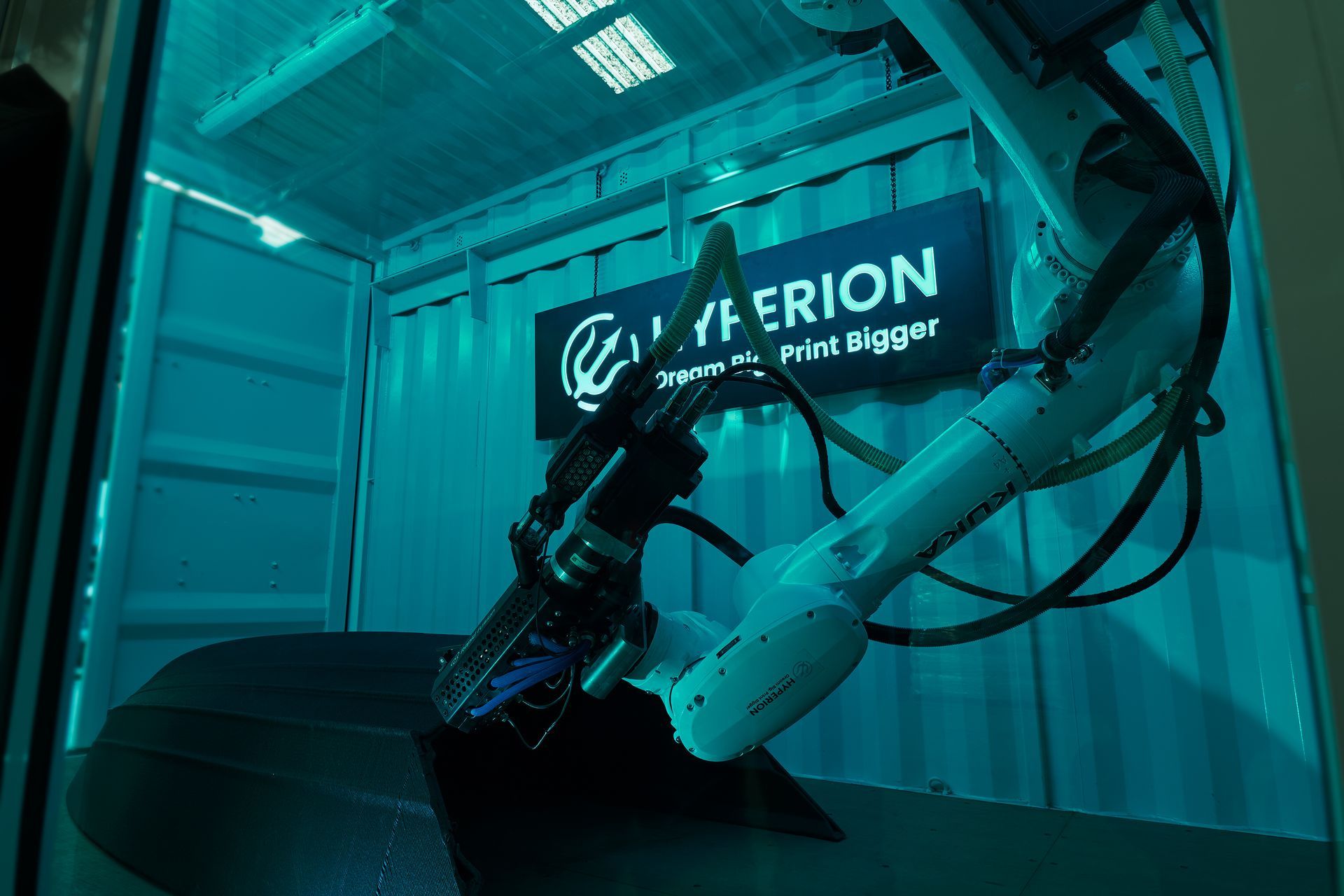
On the other hand, the resolution for FGF is less sharp. But as anybody who has just begun learning about AM could tell you, each method has its strengths and weaknesses and no single machine can do everything.
What Hyperion’s machines can do is make use of local waste plastics. FFF printers in Australia will almost always use filaments of virgin material.
Recycling as well as handling large builds has been a focus for the company, which in May displayed what it said was the Southern Hemisphere’s first AM unmanned surface vehicle. The hull of the 4.6-metre ASTRA 460 was printed in 40 hours, with fellow WA companies Versatile Marine providing design, and Greenroom Robotics contributing its autonomy platform.
And recycling has driven Wigley’s company to develop labs for testing, characterisation, compounding and performance validation of the plastics it uses and sells. There is no point printing something very large if it can’t do what’s required.
“We originally outsourced this, but our long term vision is to recycle plastics. So we had to sort of bring that in-house,” Wigley added of compounding.
“Say you want UV resistance, say you want impact resistance, say you want it to be more resistant to heat: You can add things to the plastic to get a compound out of the end that comes in the form of a pellet, which you can feed into the machines.”
The team will also incorporate various kinds of chopped fibre reinforcements where required, hence its partnership with the ACM CRC.
It has used bulk polymer from decommissioned plastic oil and gas pipelines at the Pilbara and North West Shelf, which Wigley said there is an abundant supply of.
“The plastic was just being put into landfills. So we've actually become a major user of plastic in WA because there isn't much of a plastics industry,” he added.
“We can take that and we can shred that plastic down and turn it into pellets that we can print with. We did that already with a research project with the University of Western Australia last year. We proved it out.”
Other structures the company’s robots have produced have included what it claims is Australia’s largest 3D printed structure, a public artwork at Kalgoorlie TAFE, and it plans to create the first polymer AM home in the hemisphere, in a partnership with Little Castles Small Homes.
The founder hopes to enable a decentralised manufacturing network with Hyperion’s TitanCell machines, some of which will utilise decommissioned plastic assets.
“We see a future where we have a container that's a printer and a container that's sort of a recycling plant and that forms a micro factory where people can utilise some of the waste plastic that they have in their jurisdiction, like we're doing over here in WA,” said Wigley.
“But we want to take that around the world.”
Pictures: supplied
ACM CRC welcomes engagement from industry and research partners interested in collaborating on advanced composites manufacturing initiatives. Contact us here.