10 Questions with Tanjima Akter
Our PhDs are playing a significant role within our program, and in the broader industry.
Tanjima Akter is a second-year PhD candidate in Carbon Fibre and Composites at Carbon Nexus, Institute for Frontier Materials (IFM) at Deakin University. Before starting her PhD, she completed her Masters degree in Smart Agriculture Systems based on Imaging and Spectroscopy at Chungnam National University, South Korea, and a bachelor’s degree in Agricultural Engineering at Bangladesh Agricultural University.
Tanjima is particularly dedicated to developing Green Carbon Fibre (GCF) as an energy-efficient and cost-effective alternative to conventional carbon fibre. By using low-cost materials, her work aims to reduce energy consumption and production costs while maintaining high performance. The resulting GCF has potential applications in batteries, supercapacitors, packaging, automotive components, and lightweight consumer goods.
Q1. Under which ACM CRC Research Program does your PhD project sit?
My PhD project falls under the Research Program 1: Composite Materials, which mainly highlights the development of low-cost carbon fibre and novel material systems and combinations for improved affordability.
Q2. What is the focus of your PhD?
My research focuses on turning waste materials into valuable, high‑performance fibres.
The primary aim of my research is creating green, low‑cost carbon precursor fibre using wet spinning and subsequent carbonisation into carbon fibres, while closely examining the fibre’s physicochemical, mechanical, thermal and morphological behaviour.
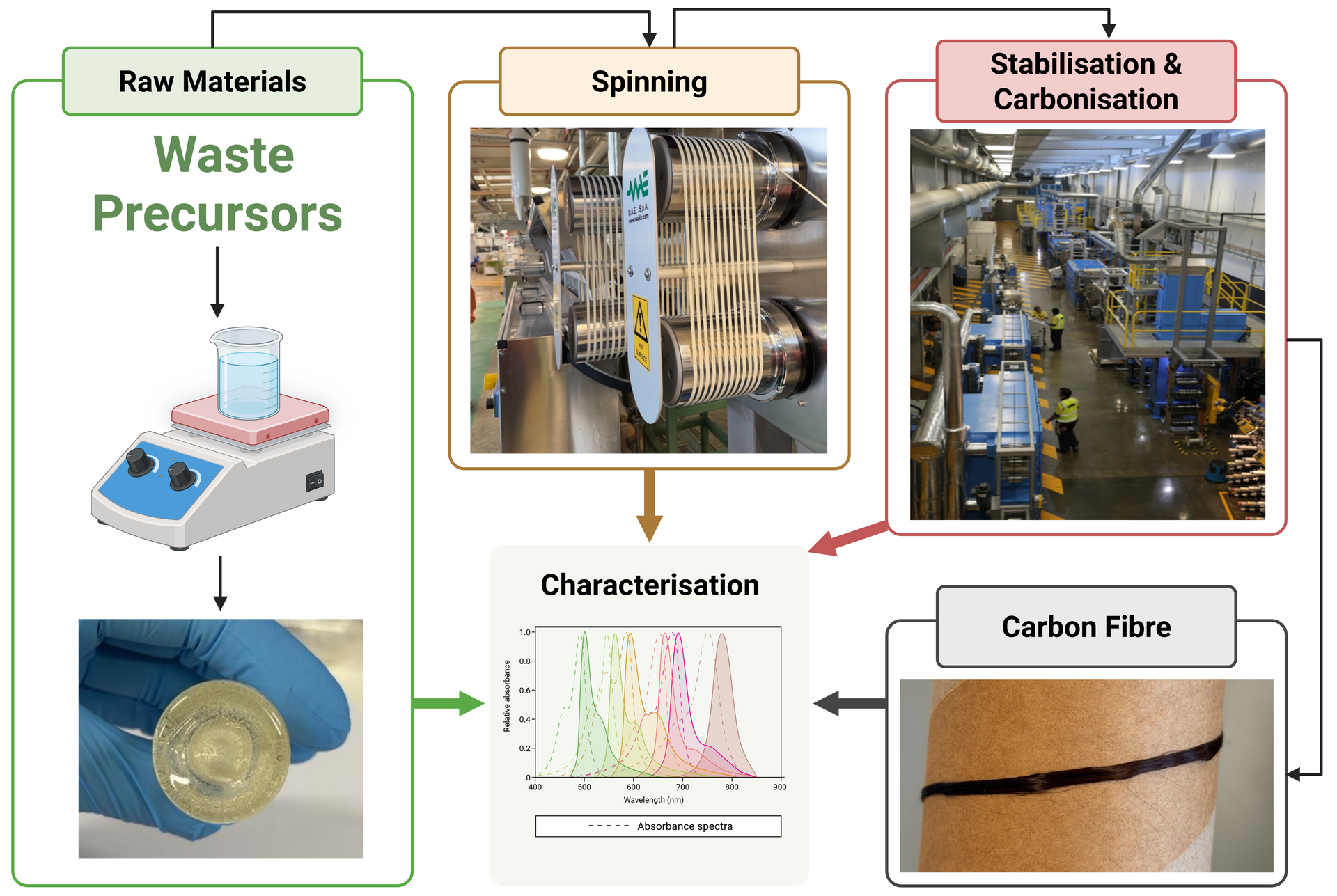
At its core, this project supports a more sustainable future for composite materials. By converting waste into advanced carbon fibre and evaluating its full life‑cycle impact, the goal is to develop composites that are not only strong and versatile but also environmentally responsible.
Q3. When did you become interested in this field?
I have had a quiet fascination with environmental waste since my undergraduate studies. Even though my earlier research focused more on engineering practices and imaging techniques, I never truly understood how waste could become a valuable material in materials engineering until I had the opportunity to work on my current project. Through this experience, I finally feel as though I have found the research path that genuinely resonates with me; one that connects me to both the environment and advanced materials, and allows me to explore new possibilities and real‑world applications for low‑cost carbon fibre.
Q4. What made you interested in it?
During my studies, I was always curious about waste, why we throw so much away, and whether those materials could have a second life. But I never imagined that waste could become something as strong and valuable as carbon fibre.
When I began working on this project, everything changed. I saw how wet-spinning, stabilisation, and carbonisation could turn discarded materials into high‑performance fibres. I started exploring how the fibre flows, how it reacts to heat, how its structure forms, and suddenly the science felt alive.
That was the moment it clicked for me. I realised I wasn’t just studying materials; I was discovering new possibilities for sustainability. Turning waste into something useful and imagining real‑world applications made me feel like I had finally found the research path that truly fits me.
It became more than a project; it became a purpose.
Q5. What do you hope to achieve through your PhD? What challenges are you hoping to solve?
As a second‑year PhD student, I know there is always something new to learn, and I am still growing every day. Being part of A/Prof. Claudia Creighton’s group at Carbon Nexus has opened the door to many areas of carbon fibre research and manufacturing, and I hope to build strong skills across these fields.
The challenge at the heart of my project is a big one: producing green carbon fibre from waste on a larger scale. Unlike commercial PAN, waste‑based precursors behave differently, so the processing steps and parameters can be tough to control. But that’s exactly what motivates me. I want to help create carbon fibre that is low‑cost, low in energy and emissions, and suitable for real industrial applications. If I can contribute even a small part to making carbon fibre more sustainable and accessible, that would be a major achievement of my PhD.
Q6. What are your long-term goals/ambitions?
My long‑term ambition is to become a polymer and materials researcher who contributes to real sustainability solutions. I want to work in academia and the materials field, developing ideas that reduce environmental impact and make our world safer. Even though the future is unpredictable, I hope to build a career where I can keep exploring new materials, solving challenges and creating technologies that support a cleaner, more sustainable planet.
Q7. What’s the best thing about being an ACM CRC PhD student?
The best thing about being an ACM CRC PhD student is the sense of community. ACM CRC is not just a research and manufacturing centre; it feels like a supportive family. It’s a place where we can share ideas, solve problems together, and connect with industry partners, universities, research organisations and experts who all bring different strengths to the table.
Q8. What one piece of advice would you give to people thinking of undertaking a PhD in the composites manufacturing area?
When you start a PhD in composites manufacturing, it feels a bit like standing at the bottom of a mountain. You know the climb won’t be smooth; there will be moments when you get stuck, confused, or even feel like giving up. But the view from the top makes every step worth it.
That’s why my advice is this: choose a topic you truly care about, something you’re willing to fight for on the hard days. Passion is what keeps you moving when the research gets tough. And don’t stay in your own bubble, engage with real industrial challenges. It helps you understand the field better and makes the journey feel more meaningful.
Q.9 Tell us something about you that would surprise/impress people.
Most people are surprised when they hear where I started. I didn’t begin in materials science at all; my background was in engineering practices and imaging techniques. I never imagined I would end up studying polymers or carbon fibre. But discovering the idea of turning environmental waste into green carbon fibre changed everything. Now I am fully immersed in materials science, doing research, and that journey from my past to my present is what often impresses people.
Q.10 Anything to add?
I would like to express my sincere gratitude to ACM CRC, Carbon Nexus, Institute for Frontier Materials, Deakin University, and Carbon Revolution for giving me the opportunity to pursue my PhD, one of the most meaningful experiences of my life. I am truly thankful for the support and guidance from my supervisors, our research team and my colleagues. I am grateful to be working in a field that connects materials science with real environmental impact, and I am excited to keep learning and contributing.
Interested to know more?
Visit our Education and Training page to learn more on our HDR Program, and how it’s helping to achieve industry transformation.