Rowing and reinvention at Australian composite boatbuilding pioneer
Geelong-based Jeff Sykes & Associates, best known as Sykes Rowing, is a supplier to the Australian national team and has its eyes on their racing needs for the 2028 and 2032 Olympic cycles, extending a heritage in elite-level rowing. It is also marking its 60th anniversary this year. Below is an interview with Managing Director Mark Nothnagel.
In 1966, founder Jeff Sykes built his first boat, a handcrafted wooden single-scull, in which he won the national championships on two occasions.
Sykes Rowing builds and supplies boats for customers at all levels of skill, and four Olympic gold medals have been won by Australian athletes in Sykes boats.
The boat business employs 30 staff, some of which are rowers, with a few Olympians, explained Mark Nothnagel.
Nothnagel is the company’s third owner, acquiring the company in 2017 with the help of a few investors. He has been Managing Director since 2021.
“I decided to buy Sykes’s business because I wanted to create something special and I firmly committed to manufacturing in Australia,” said Nothnagel.
Sykes’s boatbuilding business transitioned from wood to composite materials in the early 90s, and nowadays makes boats exclusively out of composites.
It builds and sells between 200 and 300 boats a year from Breakwater, Geelong, mostly within Australia, with some exports to the USA, Europe and South Africa.
The Covid pandemic prompted a shift, with Sykes staying viable by offering its capabilities in composites to new customers, initially through large-format pattern and mould making for the marine industry.
This expanded into prototype and short-run production, then forays into new industries including aerospace, defence, industrial, infrastructure and building.
In 2025 Sykes established a separate entity, Sykes Advanced Manufacturing (SAM.) Soon after, SAM acquired the site and assets of the former Quickstep R&D division, located at Deakin University’s Waurn Ponds campus.
This broadened work into large-format additive manufacturing (with a build volume of 6 x 5 x 2 metres) and opened an avenue to work with Deakin.
Sykes prints in thermoplastic materials, with a focus on recycled thermoplastics, said Nothnagel.
AM presented a chance to source materials from recycling streams, which can later be recycled again at the end of their life and compounded into materials to “to manufacture the same products over and over again,” he added.
“Our new association with Deakin University will be important in areas such as materials development and testing, achieving compliance with building industry standards, and beyond.”
“This is the type of thinking we took to the City of Greater Geelong (COGG) as a concept for their Bollard replacement initiative,” added Nothnagel.
“With the COGG support and by collaborating with Deakin University and another Geelong company, Godfrey Hirst, Sykes is proposing to deliver a remarkable example of true circular economy for a very demanding requirement.
“You will see and read more about this in the coming months.”
On the building industry side, Sykes is currently working with three small modular builders to commercialise supply of full composite floor and bathroom panels.
“I think composites as a materials group offer a benefit that traditional building materials don't, and reduce the on-site build time significantly, leading to lower cost and faster delivery, something that is fundamentally needed in the building industry” said Nothnagel.
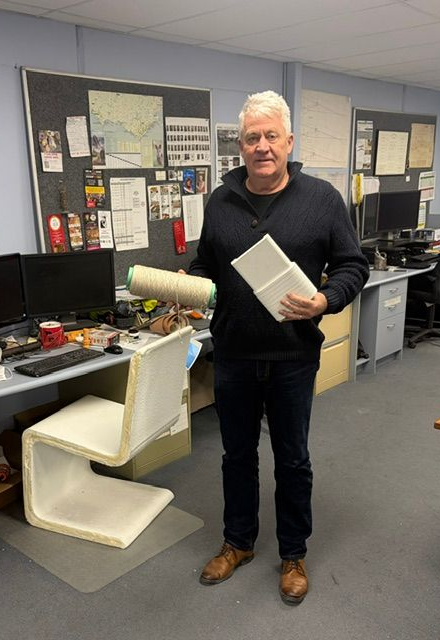
During the visit to the factory that morning, Nothnagel displayed a full-scale 3D printed window frame. “...[It is] five to ten times better in terms of thermal insulation than an aluminium window frame, is no more expensive than an aluminium or PVC [frame], and it can be made in two days in any shape,” he added.
A benefit of being alongside Sykes Rowing was being able to test and commercialise additive manufacturing internally, especially for patterns and moulds.
Besides things like figuring out the intricacies of feedstock recipes, wall thicknesses, temperature and other parameters for different applications, there’s a need for Sykes to eat their own proverbial dog food.
“I can't sell a dream to customers if I'm not using the technology myself," explained Nothnagel.
"Now, when we engage with our customers we can confidently say that this is for real because we use that technology for our own applications.”
Is it accurate to say Sykes is in a period of reinvention, after eight months of heavy R&D following the acquisition and ambitious plans for new markets?
“Absolutely,” was Nothnagel’s answer, though he was also quick to emphasise that they will also never stop focusing on the original business in world-class rowing boats.
Asked how Sykes plans to mark the upcoming 60th anniversary, Nothnagel said they would like, subject to clearance from the COGG Council, to commission a bollard representing Jeff Sykes, now well into his 80s. It would “be homed” at the Jeff Sykes Rowing Centre on the Barwon River.
The connection to the racing-obsessed founder endures, but comes with a modern, 3D printed twist.
Nothing stays the same. Sykes didn’t make its contribution to the sport – including involvement in more than 30 Olympic and World Championship medals – by being a follower.
The company’s history notes that it was the “first Australian boatbuilder to commit fully to composite construction” and the options ahead are to innovate, embrace change or fail, according to the current owner.
“The brutal reality nowadays is that it is near impossible to make a success of a labour-intensive manufacturing business in Australia because our productivity is terrible.
“Therefore we must embrace new technology and use that as the platform to expand using our unique capabilities and know-how.”
ACM CRC welcomes engagement from industry and research partners interested in collaborating on advanced composites manufacturing initiatives. Contact us
here.