9 Questions with Chundu Tamang
Our PhDs are playing a significant role within our program, and in the broader industry.
Chundu is a third-year PhD student at the University of Southern Queensland (UniSQ), an ACM CRC partner university. Before commencing her PhD, she worked as a civil engineer at the Ministry of Health (MoH) and the Centre for Bhutan Studies (CBS) in Bhutan. Her work at MoH focused on rural water, sanitation, and hygiene infrastructure, while her role at CBS involved sustainable construction and waste management.
Motivated by an interest in sustainability and circular economy, Chundu applied for a PhD project at UniSQ focused on recycling used sucker rod guides from the oil and gas industry. She is currently developing post-service waste management pathways for glass fibre reinforced Nylon 6 rod guides recovered from Coal Seam Gas wells across Australia, in collaboration with Oilfield Piping Systems (OPS).
Through her research, Chundu aims to evaluate how field-exposed composite materials can be recovered, reprocessed, and reused, contributing to a more circular approach to composite waste management in the oil and gas sector.
Q1. Under which ACM CRC Research Program does your PhD project sit?
My PhD project falls under the Research Program 1: High Performance Composites.
Q2. What is the focus of your PhD?
My PhD focuses on developing a recycling pathway for used sucker rod guides made from glass fibre-reinforced Nylon 6, in collaboration with my industry partner, Oilfield Piping Systems (OPS).
The main aim is to divert approximately 300 metric tonnes of sucker rod guide waste from landfill each year in Australia and redirect it towards recycling and remanufacturing.
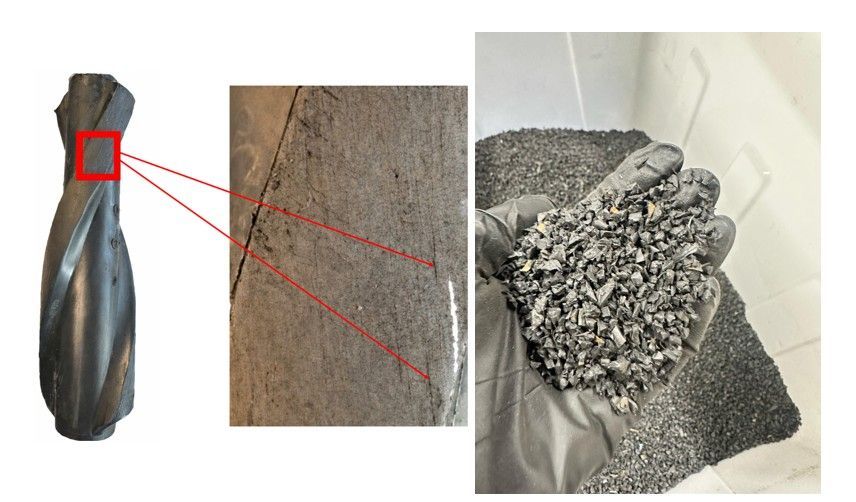
More broadly, the PhD aims to support a circular economy pathway for composite waste and bring more sustainable waste management practices into the oil and gas industry.
Q3. When did you become interested in this field?
My interest in this field developed gradually through my work as a civil engineer, where I became more aware of how material choice, service life, and waste management affect the sustainability of engineering projects. While working on sustainable construction and waste management projects in Bhutan, I became particularly interested in how engineering materials can be reused rather than simply discarded after service.
This interest became more focused when I came across the PhD project at UniSQ on recycling used sucker rod guides from the oil and gas industry. The project stood out to me because it connected my engineering background with sustainability, circular economy, and real industrial waste management challenges. It also gave me the opportunity to work on a material that has already been used in harsh field conditions, which makes the research both practical and scientifically interesting.
Q4. What made you interested in it?
The fact that around 2.4 billion sucker rod guides are simply being sent to landfill really surprised me. When I learned more about the manufacturing cost and resource consumption involved in producing sucker rod guide materials such as Nylon 6, I felt driven to make a change.
As researchers, we often get opportunities to conduct laboratory-based studies, but this project gave me the chance to work with real-world waste, materials that had undergone actual field exposure in harsh operating conditions. I knew that working on this material would allow me to contribute to something novel as a researcher. More importantly, I felt that at the end of it, I could make a real-world impact by helping to solve a critical waste problem.
Q5. What do you hope to achieve through your PhD? What challenges are you hoping to solve?
Through my PhD, I hope to develop a clear post-service pathway for composites used in harsh operating conditions. The challenge I am hoping to solve is not only technical, but also related to how oil and gas operators and their clients view these materials after service.
At the moment, used sucker rod guides are often treated as waste once they are removed from the field. Through my research, I hope to show that these composites can still have useful life remaining and untapped reuse potential. By producing reliable data on their mechanical, thermal, chemical, and durability performance, I want to support this shift in perspective and help create a more practical route for recycling and remanufacturing composite waste from the oil and gas industry.
Q6. What are your long-term goals/ambitions?
My long-term goal is to show that even profit-driven industries can make environmentally sound decisions and actively prioritise sustainability when the right technical evidence and practical pathways are available.
I also want to prove that composites have far more potential after service than they are often given credit for. Instead of treating them as waste and sending them to landfill, recycling and reuse should be considered first. Through my work, I hope to support this shift in thinking and contribute to more responsible material management in industries such as oil and gas.
Q7. What’s the best thing about being an ACM CRC PhD student?
The best thing about being an ACM CRC PhD student is the collaboration and industry exposure. It gives me the opportunity to work closely with both academic and industry teams, which helps keep my research practical and connected to real industry needs.
The networking opportunities are also very valuable. Through ACM CRC, I get to connect with people across different areas of composites manufacturing, learn from their experience.
Q8. What one piece of advice would you give to people thinking of undertaking a PhD in the composites manufacturing area?
My advice would be to choose a PhD topic that feels meaningful beyond the laboratory. Composites manufacturing is a very practical field, so the research becomes more valuable when it is connected to a real material problem, a real industry need, or a real sustainability challenge.
Q.9 Tell us something about you that would surprise/impress people.
Something that may surprise people is that I am probably more excited by a bag of used sucker rod guides than most people would be by a brand-new material. To me, each used component has a story, and my research is about understanding that story and finding out whether the material still has value.
Interested to know more?
Visit our Education and Training page to learn more on our HDR Program, and how it’s helping to achieve industry transformation.