10 Questions with Pooya Jafari
Our PhDs are playing a significant role within our program, and in the broader industry.
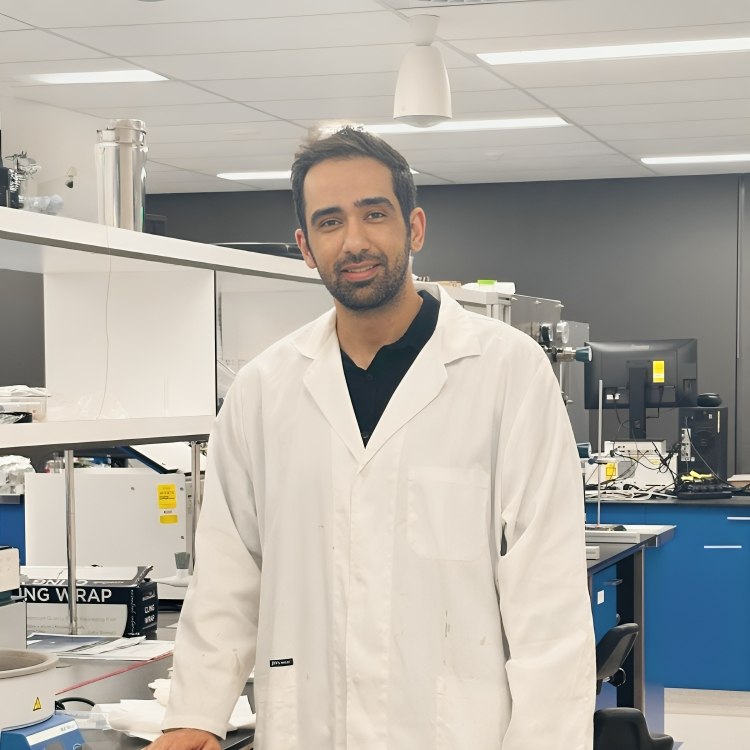
Pooya Jafari is a PhD candidate in materials engineering at the University of Southern Queensland. He has a strong focus on data-driven molecular design, cheminformatics, and artificial intelligence-powered discovery of flame-retardant polymer materials.
Pooya was awarded a Top-up scholarship by the ACM CRC and his doctoral work involves developing machine learning and generative deep learning models to design novel flame-retardant molecules and predict their performance.
Q1. Under which ACM CRC Research Program does your PhD project sit?
My research program falls under the Research Program 1: High Performance Composites. It focuses on using an AI framework to develop high performance flame retardant materials for polymers such as epoxy resin, Nylon 6, Polylactic Acid (PLA).
Q2. What is the focus of your PhD?
My PhD focuses on the data-driven discovery and design of next-generation fire-retardant polymer materials using artificial intelligence. Specifically, I develop machine learning and generative deep learning models, such as recurrent neural networks integrated with reinforcement learning, to design novel flame-retardant molecules and predict their performance in polymers like epoxy, PLA, and PA6.
The research combines computational modelling with experimental validation to optimise key properties including flame retardancy (LOI, UL-94), thermal stability, and mechanical performance. Ultimately, the goal is to accelerate the development of high-efficiency, low-loading fire retardants for advanced applications such as battery thermal management and sustainable polymer systems.
Q3. When did you become interested in this field?
I became interested in this field at the beginning of my PhD, when I was introduced to the challenge of developing more efficient fire-retardant materials for polymers. Coming from a mechanical engineering background, the opportunity to apply artificial intelligence to materials design was both new and compelling. As I explored the limitations of traditional trial-and-error approaches in discovering flame retardants, I became increasingly motivated to use machine learning and generative models to accelerate this process.
Q4. What made you interested in it?
What particularly drew me to this field was the opportunity to address a real and impactful engineering challenge: improving fire safety in polymer materials, while using advanced computational approaches. I was motivated by the limitations of conventional experimental methods, which are often time-consuming, costly, and inefficient for exploring vast chemical spaces. The idea that artificial intelligence could significantly accelerate the discovery of new flame-retardant materials, while also reducing reliance on trial-and-error experimentation, was highly appealing.
Q5. What do you hope to achieve through your PhD? What challenges are you hoping to solve?
The key challenges I am addressing include the vast and complex chemical design space, the scarcity and inconsistency of high-quality experimental data, and the difficulty of simultaneously optimising fire performance, thermal stability, and mechanical properties. Ultimately, I hope my work contributes to safer and more sustainable polymer systems, with practical applications such as improving thermal management and fire protection in areas like lithium-ion battery safety.
Q6. What are your long-term goals/ambitions?
My long-term goal is to establish myself as a leading researcher at the intersection of artificial intelligence and advanced materials design, particularly in the development of high-performance and sustainable polymer systems. I aim to continue working in academia or industry-driven research where I can lead projects that translate AI-based discoveries into real-world applications.
Q7. What’s the best thing about being an ACM CRC PhD student?
The best thing about being an ACM CRC PhD student is the strong connection between academic research and industry application. It provides the opportunity to work on real-world problems with direct relevance to advanced manufacturing, while collaborating with both leading researchers and industry partners. This environment not only enhances the practical impact of my research but also helps me develop skills beyond academia, such as project alignment with industry needs, teamwork, and communication.
Q8. What one piece of advice would you give to people thinking of undertaking a PhD in the composites manufacturing area?
One key piece of advice is to build a strong interdisciplinary foundation early on. Composites manufacturing sits at the intersection of materials science, mechanics, processing, and increasingly data-driven methods like AI and machine learning. Being open to learning beyond your original background will significantly strengthen your research and career prospects. At the same time, try to align your work with real industry challenges, as this will not only make your research more impactful but also improve your employability.
Q.9 Tell us something about you that would surprise/impress people.
I used to play basketball at a professional level, and becoming an academic, let alone pursuing a PhD, was never something I imagined for myself as a teenager. Life, however, had a different path in mind, and it gradually led me toward a journey I had never anticipated. What makes this experience even more remarkable is how surprising it has been, not only for me, but also for those who have known me for years, to see this transformation unfold. In many ways, this journey stands as a testament to how unexpected directions can lead to meaningful and fulfilling outcomes.
Q10. Anything to add?
I would like to take this opportunity to sincerely thank the ACM CRC for supporting my PhD through this research program. The opportunity to be part of such a collaborative and industry-connected environment has been invaluable to my development, both academically and professionally. Their support has enabled me to pursue high-impact research and engage with real-world challenges, for which I am truly grateful.
Interested to know more?
Visit our Education and Training page to learn more on our HDR Program, and how it’s helping to achieve industry transformation.